
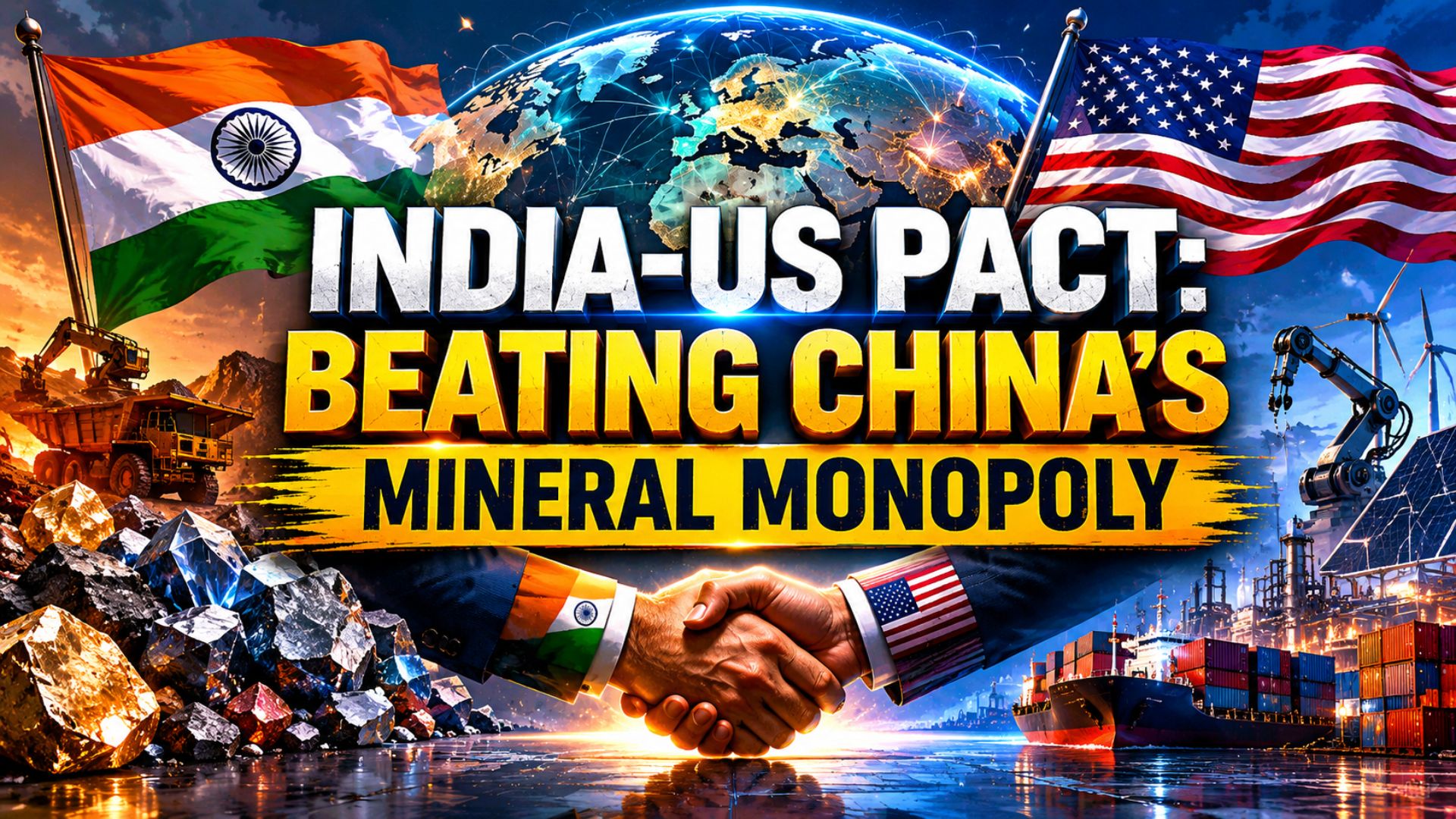
Amidst severe foreign capital flight and a volatile market, India’s new mineral pact with the US serves as a crucial economic shield against geopolitical supply shocks.
India and the US have officially signed the India-US Critical Minerals Framework. This follows India’s inclusion into Pax Silica—a Washington-led initiative designed to counter China's dominance in new-age sectors like Artificial Intelligence (AI).
The Crucial Vulnerability
China currently controls nearly 90% of global critical mineral processing. Beijing recently weaponized this monopoly by choking rare earth element exports, triggering severe supply shortages for Indian industries. Today, India remains 100% import-dependent for vital minerals like Lithium, Cobalt, Nickel, and Silicon.
To fast-track supply chain security, New Delhi calibrated its Press Note 3 (PN3) FDI rules regarding Land Bordering Countries (LBCs). Investment proposals from LBCs in specified strategic sectors such as polysilicon and rare earth magnets must now be processed and decided within a strict 60-day window.
Recent RBI data highlights a volatile economic backdrop:
- FDI Divergence: Gross FDI inflows hit a record $94.53 billion (up 17%), but actual net FDI was a mere $7.65 billion.
- Geopolitical Capital Flight: While an early February interim trade deal initially boosted investor sentiment, the outbreak of the West Asia war at the end of February triggered massive FPI capital flight. Foreign capital exited in droves: $13.6B in March, $7.56B in April, and $2.62B so far in May.
This framework, alongside the India-US TRUST initiative from PM Modi’s February 2025 US visit, marks a vital shift toward securing trusted, alternative supply chains.
Try this :
Consider the following statements regarding the India–US Critical Minerals Framework and related developments:
- The India–US Critical Minerals Framework aims to reduce dependence on China's dominance in critical mineral processing and strengthen trusted supply chains.
- China currently accounts for nearly 90% of global critical mineral processing and has recently restricted rare earth exports.
- India is self-sufficient in the production and processing of Lithium, Cobalt, Nickel, and Silicon.
- Under the revised Press Note 3 (PN3) framework, investment proposals from Land Bordering Countries in specified strategic sectors must be processed within 60 days.
Which of the statements given above is/are correct?
A. 1 and 2 only
B. 1, 2 and 4 only
C. 2, 3 and 4 only
D. 1, 2, 3 and 4